- Introduction: The Reality of Starting an Apparel Brand
- Step 1: Define Your Niche, Target Persona, and Unique Value Proposition (UVP)
- Step 2: Choose Your Apparel Business Model (Custom OEM/ODM vs. Print-on-Demand vs. Private Label)
- Step 3: Build a Lean Business Plan & Realistic Financial Budget
- Step 4: Design Your Collection & Create Professional Tech Packs
- Step 5: Source and Partner with the Right Clothing Manufacturer
- Step 6: Master the Sampling & Prototyping Phase
- Step 7: Plan Bulk Production, Quality Control (AQL), and Packaging
- Step 8: Build a High-Converting Shopify Store Optimized for Search & AI
- Step 9: Execute a Pre-Launch & Multi-Channel Marketing Strategy
- Step 10: Launch, Analyze First-Batch Performance, and Scale
- Apparel Startup Cost & Timeline Breakdown Table
- Frequently Asked Questions (FAQ) with Structured Schema
- Final Checklist & Next Steps
Introduction: The Reality of Starting an Apparel Brand
Launching a clothing line is one of the most exciting creative and entrepreneurial journeys you can take. However, the global fashion market is valued at over $1.7 trillion, making it equally rewarding and intensely competitive.
Every year, thousands of apparel startups launch with visionary sketches, only to stall at the manufacturing, supply chain, or customer acquisition stages. The difference between brands that scale to seven figures and those left with unsold inventory isn’t just creative flair—it is supply chain rigor, structured budgeting, and disciplined execution.
Whether you want to build a high-performance streetwear label, an eco-conscious activewear brand, or luxury bespoke essentials, this step-by-step master guide walks you through the exact blueprint used by successful modern apparel brands.
Step 1: Define Your Niche, Target Persona, and Unique Value Proposition (UVP)
The biggest mistake first-time fashion founders make is trying to design “clothes for everyone.” When you appeal to everyone, you appeal to no one.
1.1 Identify an Underserved Market Gap
Look for specific friction points in current market offerings:
- Functional gaps: Moisture-wicking business shirts that look tailored, petite-proportioned heavyweight hoodies, or seamless maternity activewear.
- Ethical & material gaps: 100% GOTS-certified organic cotton basics at an accessible mid-tier price point.
- Cultural/Aesthetic gaps: Minimalist unisex streetwear with Japanese architectural silhouettes.
1.2 Build Your Ideal Customer Profile (ICP)
Define your core buyer beyond broad demographics:
- Demographics: Age (e.g., 24–35), location, disposable income level, occupational background.
- Psychographics: Values (sustainability, exclusivity, comfort), lifestyle hobbies, media consumption habits (TikTok vs. Pinterest vs. Substack).
- Price Elasticity: What is their target price point for a hoodie, tee, or outerwear? (e.g., $45 mass-market vs. $120–$180 premium contemporary).
1.3 Formulate Your UVP
Complete this single-sentence formula:
“We help [Target Audience] achieve [Primary Benefit/Style] through [Proprietary Material/Design Feature], without [Common Industry Compromise/Pain Point].”
Step 2: Choose Your Apparel Business Model
Before designing a single garment, establish your production and fulfillment model.
Business Model How It Works Upfront
CapitalProfit Margin Brand Equity /Customization Best Suited For Custom OEM / Cut & Sew (Recommended for Real Brands) Custom fabrics,
exact patterns, labels, and sizing tailored to your exact tech packs.Medium to High ($2,000–$15,000) High (50%–75%) Maximum (100% unique brand assets) Serious fashion startups, DTC brands aiming for long-term growth. ODM / Private Label Choose pre-developed blanks or factory styles and add your custom tags, prints. Low to Medium ($1500–$5,000) Moderate (40%–60%) Medium (Standard silhouette with custom branding) Fast-turnaround capsule collections, influencer merchandise. Print-on-Demand (POD) Graphics printed on generic stock blanks as orders arrive; Very Low ($100–$500) Low (15%–30%) Very Low (Generic fit, inconsistent quality control) Testing graphic concepts and slogan tees.
Step 3: Build a Lean Business Plan & Realistic Financial Budget
You don’t need a 50-page formal bank document, but you must know your unit economics and working capital requirements before issuing purchase orders.
3.1 Financial Rule of Thumb: The 40-30-20-10 Allocation
Allocate your initial startup capital across these core buckets:
- 40% Production & Sampling: Tech pack creation, sample iterations, bulk fabric, cutting/sewing, custom trims, tags, and freight/duties.
- 30% Customer Acquisition & Marketing: Influencer seeding, lifestyle photography, paid ads (Meta/TikTok), and PR.
- 20% Technology & Operations: Shopify store setup, domain, apps, packaging materials, and fulfillment software.
- 10% Working Capital Contingency: Buffer for unexpected freight surcharges, import tariffs, or rush sampling fees.
3.2 Target Unit Economics (Cost of Goods Sold – COGS)
To maintain a profitable DTC e-commerce operation:
- Target Retail Price (MSRP): 3.5x to 5x your Landed Cost per unit (Landed Cost = Manufacturing + Trims + Freight + Import Duty).
- Example: If a heavyweight custom French Terry hoodie costs $22 landed, your retail price should be $88–$110.
Step 4: Design Your Collection & Create Professional Tech Packs
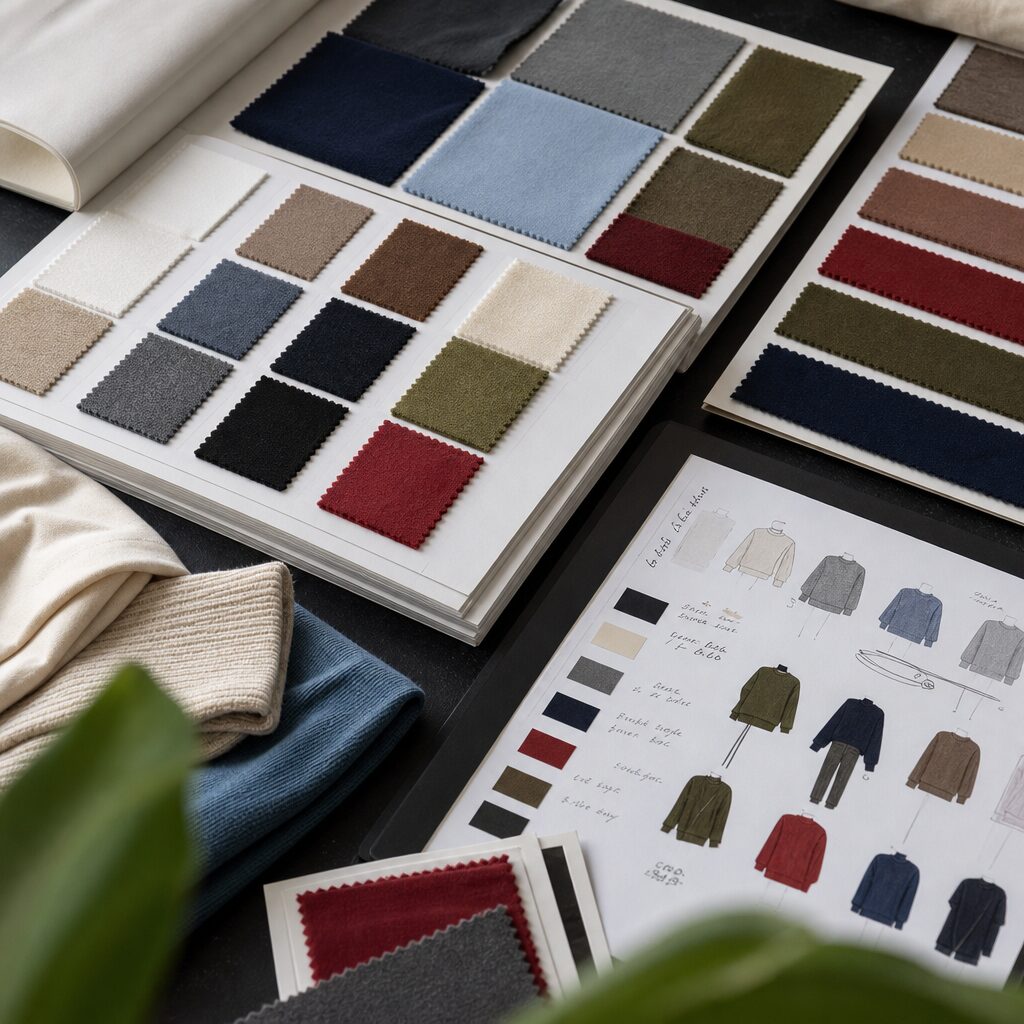
A manufacturer cannot build your garment from an Instagram screenshot or rough pencil sketch. In professional manufacturing, the Tech Pack (Technical Package) is your legally binding production blueprint.
+———————————————————————————+
| TECH PACK ANATOMY |
+———————————————————————————+
| 1. Flat Technical Sketches (Front / Back / Side with callouts) |
| 2. Bill of Materials (BOM): Main fabric, lining, ribbing, zippers, threads |
| 3. Graded Size Spec Sheet (POM – Points of Measure: chest, length, sleeve…) |
| 4. Colorways & Pantone TCX / TPX codes |
| 5. Artwork / Graphics Placement (Dimensions in cm, printing method: screen/DTG)|
| 6. Trims & Labeling: Woven main labels, care labels, hangtags, custom polybags |
+———————————————————————————+
4.1 Launch with a Focused Capsule Collection (3–5 SKUs)
Do not launch with 20 different styles. Start with 3 to 5 core hero items (e.g., 1 Signature Hoodie, 1 Oversized Tee, 1 Custom Sweatpant). This allows you to:
- Maximize fabric efficiency and lower supplier Minimum Order Quantities (MOQ).
- Gather fast customer feedback on fit and silhouette.
- Focus your marketing budget on telling one clear product story.
Step 5: Source and Partner with the Right Clothing Manufacturer
Your manufacturing partner is the operational backbone of your brand. A poor partner leads to delayed seasons, sizing inconsistencies, and defective bulk orders.
5.1 Where to Source
- Overseas Custom Hubs (China – Dongguan/Guangzhou, Vietnam, Portugal, Turkey): Ideal for comprehensive cut-and-sew, complex wash treatments, technical fabrics, and full-package custom apparel at scalable price points.
- Domestic / Local Manufacturers: Faster shipping and no language barrier, but significantly higher labor costs and limited custom fabric milling capabilities.
5.2 Five Essential Questions to Vet Any Apparel Manufacturer
- What is your Minimum Order Quantity (MOQ) per style and per color? (Look for manufacturers offering flexible low MOQs of 50–100 pcs for startups).
- Do you provide Full Package Production (FPP) or Cut-Make-Trim (CMT)? (FPP is best for startups as the factory handles fabric sourcing, trims, pattern making, and production).
- What is your standard turnaround time for proto samples and bulk production? (Typical benchmark: 7–14 days for sampling; 25–40 days for bulk).
- What quality control standards do you enforce? (Inquire if they follow ISO standards or AQL 2.5 inspection guidelines).
- Can you handle custom branding elements (woven neck labels, embossed aglets, custom polybags)?
Step 6: Prototype & Approve Samples
Never jump straight to bulk production. Sampling protects your investment by validating fit, fabric drape, and construction before mass manufacturing.
The 3-Step Sampling Process:
- Proto Sample (Fit Check): Uses in-stock fabric to check sizing, proportions, and stitching against your tech pack.
- Pre-Production Sample (PPS – Gold Standard): Made with your final custom fabric, Pantone-matched dyes, and custom brand tags. This is your sign-off benchmark.
- Wash & Wear Test: Wash the sample 3 times to ensure zero shrinkage, pilling, or color bleeding before giving bulk approval.
Step 7: Bulk Production, QC & Packaging
Once you sign off on your PPS sample, bulk cutting and sewing begin.
Key Rules for Smooth Production:
- Set Quality Standards (AQL 2.5): Ensure your factory checks measurements within ±0.5–2 cm tolerance and inspects for loose threads or zipper defects.
- Custom Trims & Packaging: Elevate perceived value with custom frosted zip polybags, thick matte hangtags, and compliant woven neck/care labels.
- Production Timeline: Expect 15 to 30 days for standard bulk manufacturing, plus 1–2 weeks for air shipping (or 4 weeks for sea freight).
Step 8: Build a High-Converting Shopify Store
Your website must answer every buyer’s sizing and quality questions in seconds.
4 Must-Have Elements on Every Product Page (PDP):
- Multi-Angle Photos: Studio flat-lays, on-model shots, and close-ups of fabric texture and stitching.
- Detailed Size & Model Specs: Always state the model’s measurements (e.g., “Model is 6’1″ (185cm), 175 lbs wearing Size L for an oversized fit”).
- Clear Fabric Specs: Highlight premium details (e.g., “300GSM Heavyweight 100% Cotton”).
- Friction-Free Checkout & Policies: Place shipping times and easy exchange policies right below the “Add to Cart” button.
Step 9: Build Pre-Launch Hype (4–6 Weeks Before Drop)
Don’t wait for bulk inventory to land before marketing. Start building an audience early:
- Document the Behind-the-Scenes (BTS): Post short-form videos (TikTok, Reels, Shorts) showing sample unboxings, fit trials, and fabric stress tests.
- Seed 20–30 Micro-Creators: Send pre-production samples to niche creators (5K–50K followers) for organic styling and honest feedback.
- Build an Exclusive VIP Waitlist: Offer early 2-hour launch access or a limited gift for early email/SMS signups.
Step 10: Launch & Track 3 Core Metrics
When your inventory arrives, launch to your VIP list first, then open to the public.
Focus on These 3 Numbers in Your First 30 Days:
- Return Rate by Size: If one size is consistently returned, adjust your sizing chart or factory pattern grading immediately.
- Customer Feedback: Note recurring comments about fabric weight, softness, or fit.
- Best-Seller Velocity: Identify your #1 selling SKU within week two so you can place timely reorders before stockouts happen.
Frequently Asked Questions (FAQ)
How much money do you realistically need to start a clothing brand?
For a professional custom cut-and-sew brand launching with 3 styles (50–100 pieces per style), a realistic starting budget is between $7,000 and $15,000. This covers tech packs, sampling, bulk production, custom branding, website setup, and initial marketing. Founders using print-on-demand can start for under $1,000, though profit margins and brand equity will be substantially lower.
What is the Minimum Order Quantity (MOQ) for custom clothing?
Traditional apparel factories often require 300 to 500 pieces per style/color. However, modern agile manufacturers specializing in apparel startups offer flexible low MOQs starting at 50 to 100 pieces per style, making custom development accessible for emerging brands.
Do I need a fashion design degree to start a clothing line?
No. You do not need formal fashion education. You need a clear creative vision and professional Tech Packs. You can collaborate with freelance fashion technical designers to turn your reference samples or mood boards into factory-ready technical specifications.
How long does it take from initial concept to launch day?
On average, expect 3 to 5 months from initial concept to launch:
- Concept & Tech Packs: 3–4 weeks
- Sampling & Revisions: 3–5 weeks
- Bulk Production: 4–6 weeks
- Freight, Fulfillment & Store Setup: 2–3 weeks
Ready to Turn Your Fashion Concepts into Reality?
Whether you need assistance with low-MOQ sample development, tech pack translation, or full-package custom bulk production, our expert manufacturing team is here to support your journey.
👉 Submit Your Tech Pack or Request a Free Sample Consultation Today
📥 Download Our 2026 Apparel Startup Sourcing & Cost Guide (PDF)